

The 10 benefits of the connected fitting room
To improve the in-store customer experience, more and more brands are opting for the connected fitting room. The aim: to help shoppers find their size more easily, to optimise stock and, in doing so, to drive conversion.
Here is how it works, what its many benefits are, and how it compares with virtual try-on and body scanners.
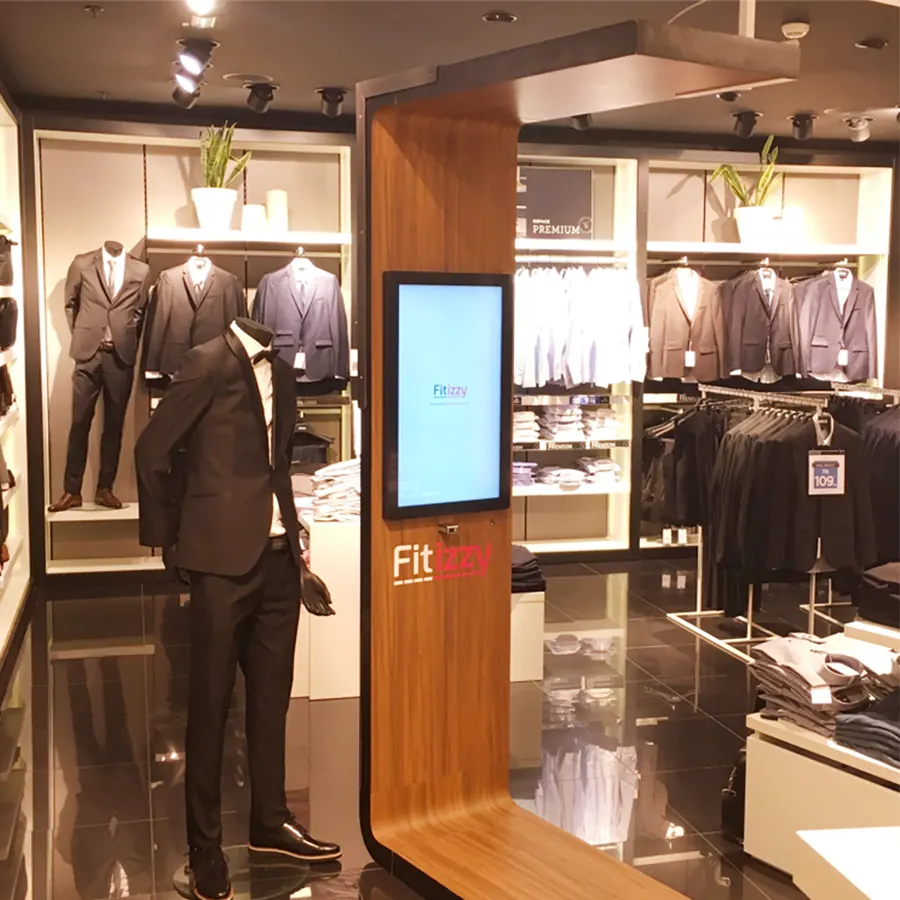
For years, many ready-to-wear retailers have found that the fitting room simply isn’t appealing enough to their customers.
- Only 18% of them use it when they visit a store.
- 35% of shoppers would rather leave an item behind than go and try it on.
It has to be said that a fitting session can come with plenty of drawbacks:
- fairly long waiting times,
- spaces that are often poorly designed,
- lighting that flatters neither the product nor the customer,
- going back to the rails to find another size to try on,
- getting undressed all over again…
Not to mention the many restrictions introduced in stores in response to Covid-19.
Very often, customers see the whole thing as a waste of time, or even as a frustration when the item doesn’t suit them.
Paradoxically, fitting rooms play a key role in the purchase journey.
- 60% of visits to a fitting room end in a purchase.
- The closer they are to the tills, the more these fitting rooms encourage people to buy.
To breathe new life into this conversion space, several ready-to-wear brands are now turning to Fitizzy’s connected fitting room, the Fitiroom.
How does the Fitiroom connected fitting room work?
Every brand grades its sizes differently. As a shopper, it is hard to find your way around.
To spare customers the frustration and retailers the lost sales, we developed this solution to make choosing a clothing size in store easier.
The Fitiroom has a touchscreen and sensors. Thanks to this technology, in a matter of seconds and without having to get undressed, the shopper discovers:
- all of their sizes across the brand’s different categories,
- the products available according to what is in stock in the store,
- recommendations for similar items.
Beyond the sales it generates, the Fitiroom allows the brand to analyse its in-store traffic and optimise its supply chain. One men’s ready-to-wear brand using this connected fitting room, for example, uncovered a difference in its clientele between weekdays and weekends:
- During the week, its customers are on the young side and buy small sizes.
- At the weekend, it sees more shoppers in their forties, and they buy larger sizes.
The connected fitting room offers 10 benefits
It:
- reassures the customer about their purchase,
- saves them time,
- keeps traffic flowing in the fitting rooms,
- helps sales assistants advise customers,
- solves the problems that come with fitting rooms (such as getting undressed),
- boosts in-store sales,
- collects a wealth of in-store data, useful for optimising stock,
- fits the health measures taken against Covid-19, as it reduces direct contact.
- gives the retailer’s brand image a lift,
- is part of a “customer centric” approach, geared more closely to what shoppers need.
What are the differences between virtual try-on, body scanners and the connected fitting room?
A retailer looking to roll out a fitting-assistance solution in its stores needs to ask itself the following questions: is it for communications and marketing purposes, or is it to improve the customer experience and, at the same time, cut the time customers spend in the fitting room? Is this a marketing and comms issue, or a business issue?
With virtual try-on, shoppers find themselves in front of a screen where they see themselves with clothes superimposed on their body. On paper, virtual try-on is the dream experience. In practice, though, the rendering and the technology are not yet fully up to scratch, and modelling clothes in 3D is expensive. The virtual try-on experience is not yet good enough.
With body scanners, shoppers strip down to their underwear in a booth and their body is scanned in great detail by infrared-type technologies in order to model it in 3D. It is a sophisticated solution, but what added value does it bring the customer once they are standing in a booth in their underwear? At that point, all that is left for them to do is slip the garment on to find out whether it suits them or not. On top of that, the technology is very expensive, takes up floor space in store and ties up staff, since someone is needed to start the modelling.
Faced with these two solutions, the Fitizzy team set out to create a solution that is:
- simple for the shopper, so that they don’t have to get undressed and can use it on their own,
- doesn’t take up too much room in store, is easy for sales assistants to run, and doesn’t cost too much.
It was from these observations that the Fitiroom was born in 2018.
Towards a 2.0 business model thanks to the connected fitting room
Beyond that, knowing your customers’ morphology is THE challenge facing the clothing sector. That comes above all from analysing data in store and online.
By adopting the Fitiroom and, more broadly, Fitizzy’s size recommendation tools (online plugin, Data platform), many brands are shifting to a 2.0 business model, one more closely geared to customer needs, as the diagram below shows:
This “customer centric” approach is essential today. More than ever, the strength of the relationship with the shopper at every touchpoint (before, during and after the purchase) is a key success factor.
If you would like to try the Fitiroom in your stores, do get in touch. Our experts will answer your questions and give you a personalised demonstration of our solution.
Let’s talk about your needs