

Which data should you collect to perform in retail?
E-commerce, social media, physical stores… The volume of data collected by retailers has never been so great, and neither has the processing and the use made of it. For textile brands, the challenge today is no longer simply to use all this data, but to know how to cross-reference it, matching what is collected online with what is gathered in store. All of this in order to:
- improve the customer experience,
- and the commercial performance of their business.
But do you know which data to collect and how to make use of it? Let's find out together!
Collecting data is nothing new in the retail sector. Brands have always gathered information by studying till receipts and loyalty cards. Today, on top of that, we are able to collect a wealth of contextual data about the user and their behaviour. What has changed now is the fine-grained analysis that can be carried out on this data thanks to solutions built on Big data. These tools make it possible to understand customers' needs and behaviour better, and to anticipate them. All of this in order to build their loyalty and to make sound investment decisions.
This new use of data allows brands to adopt a customer-value approach. According to the Fédération de la Haute Couture et de la Mode (FHCM), "the customer-value approach consists in developing the company's products and services so that they are as closely aligned as possible with the expectations of an individual customer or of a group of consumers (communities, cohorts, segments…). The aim is to maximise the long-term financial value that customers bring".
This approach serves several purposes:
- winning customers,
- keeping them loyal,
- maximising their economic contribution
- and making marketing spend pay off.
3 steps to "developing a robust data approach" in the textile industry
In its study "Les nouveaux modèles économiques de la mode", the FHCM argues that clothing retailers need to follow the three steps below in order to "develop a robust data approach" and improve their customer value:
- "Capture and structure customer data: collect and expose the data. Brands have to choose which data is essential to work with.
- Analyse the data and draw conclusions from it: you need to begin with simple statistical analyses of customer data before you can refine them.
- Move to action iteratively: taking action makes it possible to measure the results and to correct operations accordingly. Data supports decision-making, and an iterative approach makes it possible to run tests and then adjust. On the basis of those first analyses, it is therefore vital to turn the lessons learned into concrete operations, which can be adapted later on."
Collecting data in the textile industry: what for?
1. To meet customer expectations better
Size, shapes, tastes, price and so on. Here, data makes it possible to anticipate trends and what customers want. Analysing it can help designers create "products for the people, by the people". This approach of involving the customer community and using data in the design of collections is becoming more and more common.
For several months now, for example, Promod has been producing on demand. The brand recently asked its community: "Which jumper would you like to see in the next collection?". At the end of that survey, 3 models & 5 colours were selected, made up in a lovely knit & produced on demand.
To find out more: https://vimeo.com/592038317/913c1b6616
2. To personalise your communications, win customers and keep them loyal
Today, data makes it possible to put in place more targeted and personalised communications, designed to keep customers loyal and to reach them at the right moment.
"CRM (customer relationship management) systems used to be based on what is known as the RFM approach (recency, frequency, monetary value), focusing on purchase frequency, the date of the last purchase and purchase value", the FHCM explains.
In this case, marketing efforts focus on using the data to roll out targeted communications (through newsletters, for instance). Gone are the traditional marketing budgets built around marketing campaigns or press relations.
3. To make better investment decisions
In the textile sector, knowing which sizes, colours and models… are most in demand allows a brand:
- to produce exactly the right number of models and sizes,
- to manage its stock better,
- to produce collections that are better matched to current needs.
All the more so because, according to a recent study by the Kantar institute, the gap between what fashion offers and the body shapes of the population is widening. Too many shoppers (19.2% of women and 15.8% of men) feel they cannot find their size when they go into a store! According to that study, there is a genuine "sense of mismatch between the size grading of the products on sale and the reality of people's measurements".
The main reasons:
- Height is almost never taken into account when collections are designed. Most garments are standardised for women between 1.65m and 1.72m tall.
- The vast majority of what is on offer comes in sizes 36/38, while 41% of women wear sizes 42, 44 and 46. The latter are desperately short of options, while the other half of women are buried under an offer that does not necessarily match their expectations.
- Among older shoppers, "small frames" are forgotten. Enough to leave them having their clothes altered all the time.
At a time when brands are winning back the market and hunting down unsold stock, it is urgent for them to look closely at real body shapes.
How can you collect this data in the textile industry?
Fitizzy's size recommendation plugin meets all of these objectives. For several years now it has been used by clothing brands to get a better grasp of their customers' needs and of market trends. Those brands may sell consumer clothing (Promod, Cyrillus, Celio…) or professional clothing and uniforms (Mulliez-Flory, Bragard).
Installed on these brands' e-commerce sites, the solution was designed first and foremost to offer shoppers size recommendations based on the product they have chosen. On a product page, when a visitor clicks on "Find your size", they enter a few pieces of information about their body. The plugin cross-references those details with the brand's technical data in order to give them a recommendation for the most accurate size for the garment they have chosen.
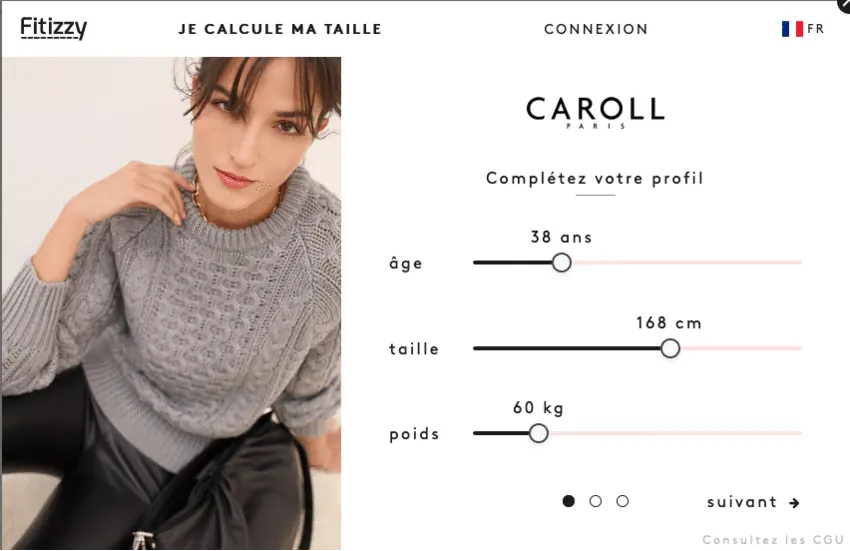
On the brand side, the plugin also supplies particularly interesting data:
- the number of pages viewed on their e-commerce site,
- the number of clicks on the call-to-action button,
- the number of times the plugin was opened by a visitor,
- the content of the recommendation given,
- products added to the basket,
- purchase or basket abandonment
- basket value
- the number of models and sizes sold online.
Through a dedicated dashboard, each brand finds all of its data set out as charts. And these performance indicators are now used:
- by its marketing department to improve the performance of its e-commerce site,
- by its pattern makers to optimise new collections by analysing the morphological data of the moment (identifying the body shapes most in demand among customers in order to manage stock allocation).
The goal: to be more efficient!
Would you like to digitalise your purchase journeys?
If you sell consumer or professional clothing, lingerie or footwear, and if you would like to improve your online offer and manage your production and your stock better, do get in touch. Our experts will answer your questions and give you a personalised demonstration of our solution.
Request a demo