

Connected fitting rooms: what stores actually use
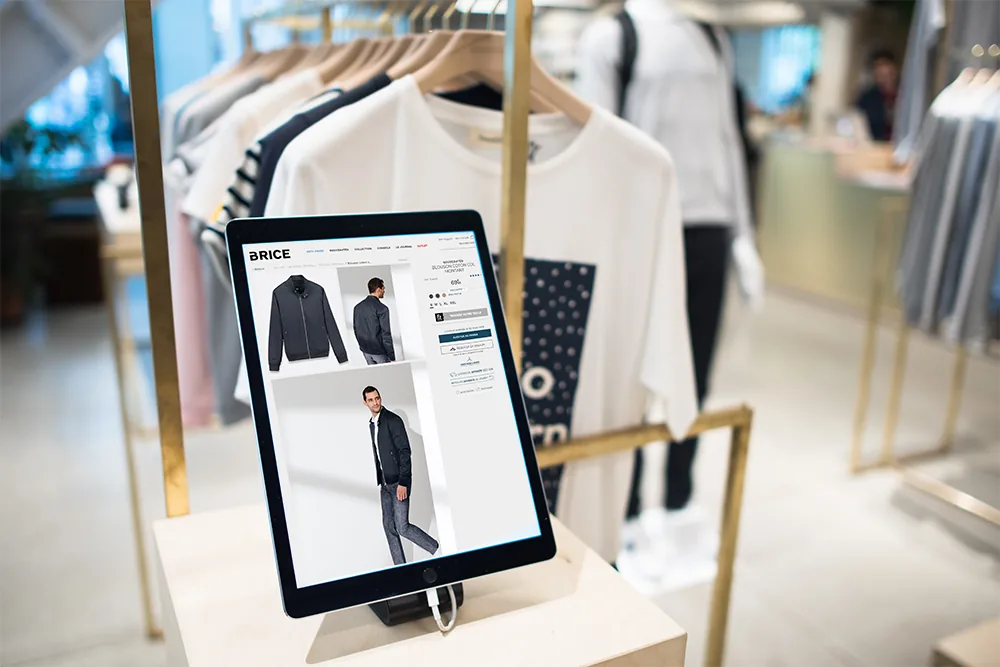
Type “virtual fitting room” into a search engine and you get 3D avatars, mirrors that dress your reflection and trade-show demos. Then walk into a clothing store: the fitting room is still a fitting room, with a curtain, a mirror and a customer who has taken two sizes of the same trousers just to be safe.
The gap between those two pictures says most of what matters. What stores actually use, when they “connect” the fitting room, is more modest and more useful: reliable size information, available in the right place, for the customer and for the sales associate. That is the ground Fitizzy works on in stores, and that is what this post describes, without promising what does not exist yet.
The problem a store is trying to solve
In a store, the size question costs time and sales. The customer hesitates between two sizes, takes both into the fitting room, and comes out with one or none. The sales associate, if one is free, advises from memory. Trips between the fitting room and the rail keep everyone busy, and a customer who cannot find their size on the rail often leaves without asking whether it is in the stockroom.
In that setting, connecting the fitting room means three concrete things: give the customer their size before they step into the cubicle, give the associate the products that suit the customer’s body shape and are actually in stock, and make sure both pieces of information match what the brand’s website says.
What stores actually use
The set-ups we see last are the ones that rely on devices already in the store. On the Fitizzy for stores page, there are four of them.
The customer’s phone. With the Fitizzy mobile app, the customer scans the barcode on the label and finds the product with its size recommendation. They need nobody to get an answer, and no fitting room to free up.
The associate’s tablet. The digital tools for sales staff suggest the products that best suit the customer, based on their body shape and on available stock. Advice no longer depends on the memory of whoever is on shift that day, and a new starter advises with the same information as a veteran.
The kiosk in the aisle. A kiosk or a screen on the shop floor gives the same information to customers who would rather not take out their phone or wait for an associate.
Fitiroom. This is the closest thing to what people call a connected fitting room: in a few seconds it recommends sizes by product category and suggests personalised looks. It also works outside fashion retail: in professional clothing, set up at the workplace, it gives every employee their full set of sizes.
For retailers that already have their own screens or app, the Fitizzy SDK plugs the same recommendation into existing interfaces, rather than adding one more device.
What recommendation does, and what it does not
Size recommendation compares the customer’s body shape with the actual grading of each item. It answers one precise question: which size of this particular garment will fit you best, and where it is likely to pull or hang loose.
It does not show the garment worn on your silhouette in 3D, and we do not present it that way. Rendering a garment on a body is a different subject, more spectacular in a demo, and one that does not yet reliably tell you whether the size is right. For a store, that last piece of information is what makes the sale and avoids a return.
Joining up with the website
The point most often overlooked is continuity between store and website. A customer who got a recommendation online should get the same one on the shop floor, and the other way round. Otherwise they compare two answers, trust neither, and go back to the old habit: taking two sizes.
That is the whole point of relying on the same recommendation for the product-page plugin and for the in-store devices: each item’s grading is set up once, and the answer does not change with the screen that gives it.
Before you equip a store
- Start from what is already there. Sales tablets, screens, the retailer’s own app: it is simpler to plug recommendation into them than to install a new device nobody maintains.
- Train the sales team. A tool the associate never offers stays switched off. They need to know when to bring it out, and for which customer.
- Check the product data. Recommendation is only as good as each item’s measurements. A poorly documented collection gives an approximate answer, online and in store.
- Tie recommendation to stock. The right size missing from the rail should be found in the stockroom or ordered, without the customer having to ask.
- Measure what matters to you. Time spent in fitting rooms, items taken in per try-on session, sales closed after advice: pick your indicators before the installation, not after.
In short
The connected fitting room that works today does not replace the mirror. It puts a reliable answer about size into the hands of the customer and the associate, on devices they already have, and keeps it consistent with the website. The rest may come, but it is not what sells a pair of trousers in the right size on a Saturday afternoon.
Do you run a store network and want to see what this would look like for you? Let’s talk about your stores.
Frequently asked questions
Does Fitizzy offer a virtual fitting room?
Not in the sense of an avatar or a mirror that dresses your reflection. Fitizzy recommends the right size of each item, on the customer’s phone, the associate’s tablet, a kiosk or Fitiroom, from the customer’s body shape and the garment’s actual grading.
What is Fitiroom?
A set-up installed in a store or at a workplace that, in a few seconds, recommends sizes by product category and suggests personalised looks. In professional clothing, it gives every employee their full set of sizes.
Do you need a new device to connect the fitting room?
Not necessarily. The mobile app runs on the customer’s phone, and the Fitizzy SDK plugs recommendation into the tablets, screens and apps the retailer already has.