

E-commerce: turning your visitors into satisfied customers.

Ready-to-wear brands have understood perfectly well that they need to redouble their efforts to capture consumers’ attention. Their digital world matters more and more: it lets connected consumers discover the brand’s universe whenever and wherever they like, hence the importance of building a strong digital strategy and, if possible, one that encourages people online to make the trip to the shop.
We live in a connected, hyper-competitive world that lends itself to customer disloyalty, with shoppers forever in search of something “new” and something “better”.
So how do you come out on top?
By making the most of the digital experience that the visitor has with the brand. E-commerce is part of a company’s overall ecosystem: its vision and its values have to come through in its digital world, and above all they have to make visitors want to find out more and to be part of its adventure.
But don’t stop there! Winning over a visitor with your universe and your creations is wonderful. Getting them to buy is even better, but a great deal harder.
On average, a visitor will have looked at around fifty shop pages (listing pages and product pages) before making a purchase, and almost ¾ of those pages are viewed during non-transactional sessions*: this is “window shopping”, the pastime of “strolling past shop windows”, which has gone digital too, much to online retailers’ dismay.
It is therefore essential to put in place every lever available to convert these “strollers” quickly. Fortunately, more and more digital solutions are springing up to answer that reality; take, for example:
- long scrolling, which spares the customer a wait for pages to load and stops them giving up.
- the wish list, which acts as a shortlist and tips over into adding to the basket.
- community chat, which offers a warm welcome and creates a bond with the visitor.
- the shopping assistant, which reassures visitors and encourages them to buy.
Let’s take a closer look at that last solution, which is specific to the ready-to-wear sector and answers a problem we all know: choosing the wrong size. Everyone knows that online there is nothing to guarantee that the item we have fallen for will live up to our expectations, or that it will hug our curves the way we would like it to…
The birth of shopping assistants
Unlike avatars and virtual fitting rooms (more of a distraction than anything else), shopping assistants are tools that step in to speed up the buying process. They reassure customers by removing the main barrier to buying online: THE choice of size before adding to the basket.
For the shopper, it is reliable, welcome help that confirms their choice; and for the brand, it is a sales-support tool that fits into its digital world and drives its e-commerce revenue.
Sceptical?
Don’t be: we have recorded an increase in the conversion rate of between 1 and 5% on the sites that offer this tool to their customers. A pretty striking result when you consider that these tools are not yet part of everyday life for most people online.
The good news is that shopping assistants take little work and earn brands money. Geese that lay golden eggs. A personalised, intuitive service that is easy to install, grows online sales and reduces product returns – the cost of which is anything but negligible.
Let’s illustrate the financial impact of size mistakes, based on 50,000 sales a month:
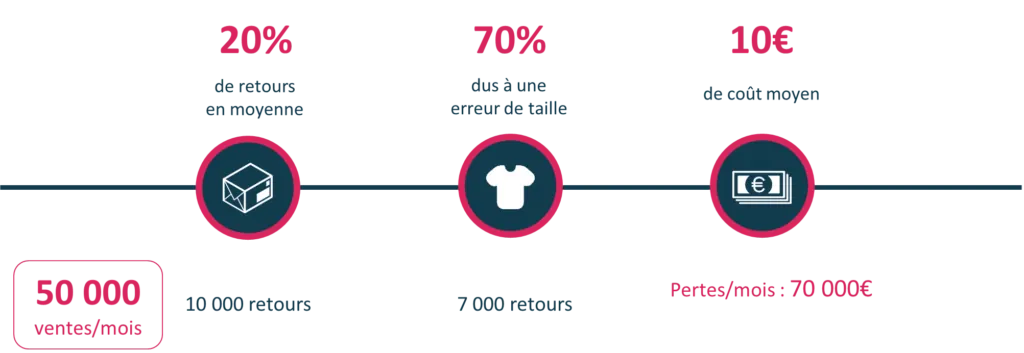
With a shopping assistant, brands could hold on to that money (and that is the point to take away).
There are several shopping assistants around today, but only a tiny fraction of people online know about them and use them. It is probably only a matter of time. If your curiosity is piqued, let me invite you to discover the Fitizzy solution, which combines simplicity and precision.
The fruit of several years of research and development, this solution takes the form of a plugin on the product pages of merchant sites. The visitor only has to click on it, enter four basic pieces of information and click the “find your size” button. Fitizzy’s equations and algorithms then analyse that data and work out their body profile, before recommending the right size for the product they have chosen.
This shopping assistant therefore rounds out the range of solutions that help online retailers make the buying process easier, whether the purchase is made online or across channels. Once visitors know their size for the product they like, they are free to add it to their wishlist or their basket, or to use e-reservation if they want to try it on or pick it up in the shop.
Another interesting aspect of Fitizzy: its social dimension, which makes it a traffic generator for online retailers. Anyone can create an account on the Fitizzy.com site to save their morphological profile and invite the people around them to do the same. Thanks to that, everyone can now find out the size of their friends and family through the Fitizzy plugin, and buy them clothes with complete peace of mind.
Sources: *Content square – study carried out over 6 months between November 2014 and April 2014