

How is Mulliez-Flory going paperless with measuring for professional clothing?
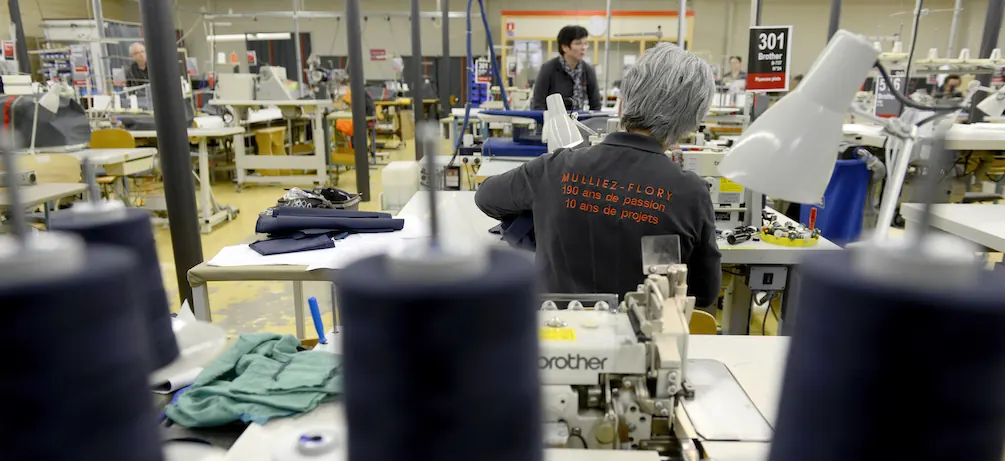
A specialist in professional clothing, Mulliez-Flory is now a name no one can ignore. Based in Cholet, France, the group produces different types of garments (uniforms, workwear, corporate wear, PPE, flat linen) used by a very wide range of sectors (healthcare, urban transport, industry, retail and so on).
Founded nearly 200 years ago, the group is still constantly seeking out innovation in order to remain a leader in this market. And so, to make remote measuring easier, Mulliez-Flory has been using our FitiPro solution since July 2020.
Thomas Poulin, who is in charge of innovation within the group, and Anthony Durand, business development manager (E-Dress/connected garments), explain how it fits into their growth strategy.
Make your professional clothing campaigns easier with FitiPro
During your clothing campaigns, the FitiPro solution takes the strain out of everything from measuring all of your staff to distributing uniforms and professional clothing on site. Thanks to this technological innovation, companies:
- manage their various campaigns for their various audiences,
- provide them with size recommendations,
- allow them to order their kit directly online and by themselves.
- Order payments can also be managed there, as can returns where necessary.
With FitiPro, our aim is to make exchanges along the supply chain easier between the wearer (the employee), the company (which clothes its staff) and the manufacturer (of uniforms). All of it in order to cut costs and optimise the time spent taking measurements.
It comprises two interfaces:
- a form, called Fitiform, through which a company’s employees enter data about their body shape (height, shoulder width, chest, stomach…) as well as information specific to each job so that the garment sits perfectly.
- the solution proper, called FitiPro, which works out the user’s measurements from the data entered and offers them size recommendations for every item of professional clothing to be ordered.
Find out more: https://www.fitizzy.com/simplifier-gestion-campagne-habillement-professionnel/
Why did the Mulliez-Flory group choose to use FitiPro?
Thomas Poulin: We have been working on going paperless with measuring since 2015. Taking measurements is a real cost for companies, both in logistics and in time. It means tying up people and product ranges, and agreeing dates with our clients.
On this subject the Mulliez-Flory group led the way, and ran several trials, notably with the IFTH (the French Textile and Clothing Institute) and then with competitors of Fitizzy.
It was after speaking to several players in the market that we turned to this size recommendation specialist. We have been using FitiPro since July 2020.
Going paperless with measuring inside companies is a subject that has interested us for several years. But it is clear that the Covid-19 pandemic sped the process up.
Which audiences do you use this solution with?
Anthony Durand: Since July 2020 we have tested the Fitizzy solution with different types of client.
The first clients we trialled it with were in the urban transport sector. We chose that line of business because it dresses its staff in uniforms rather than in workwear.
We made that choice because people who wear uniforms are more demanding and taking their measurements is harder. A uniform is a close-fitting garment, and sleeve length and trouser length are complex matters. Unlike workwear, which calls for more ease and more width.
That way we were able to put the FitiPro solution to the test and see whether it met those requirements.
Since May 2021 we have been using this solution to take measurements for workwear in the industrial sector. The client we chose has several sites in France.
How did you roll FitiPro out to these audiences?
Anthony Durand: The first time we used this tool, in July 2020, we chose to take measurements twice for all of the staff at our urban transport client. So:
- we carried on taking measurements manually,
- and we also took measurements through the FitiForm questionnaire.
That allowed us to test the solution and improve its algorithm.
The more verified morphological data we have, the better placed we are to capture qualitative information. Fitizzy has been recording morphological data since it was founded. By taking measurements manually alongside this digital tool, we wanted to enrich that data by building on our manual fittings. The goal: to be more and more accurate in the size recommendation.
With our second client, in industry, we ran this double measuring exercise with only 60 wearers/beta testers (about 10% of the wearers), before rolling the tool out to all of that company’s employees.
In the medium term this double check will no longer be needed, thanks to the training of the algorithm. Only measuring through the FitiForm questionnaire will be used.
Tell us how this solution is made available to your clients.
Anthony Durand: Through this FitiForm questionnaire, users enter their morphological data in order to obtain size recommendations for their professional clothing. And they do so before ordering it.
When we decide to set up paperless measuring with a client:
- We talk it through with them to calibrate the solution and show them how it works (choosing the products and collections to put online, customising their interface on FitiPro).
- We choose one of the standard questionnaires offered by Fitizzy. We put it to them so that it can be fleshed out if need be.
- Once the solution is calibrated, we launch the Fitiform process. The company passes this online questionnaire on to all of its employees so that everyone can complete it.
- We hold a series of progress reviews: who has answered the questionnaire, who is still outstanding, and so on. That allows our client to chase up the various staff members who are running late.
- We export all of the data to them in an Excel spreadsheet listing every user, every item and every size so that they can place their various orders.
Is FitiPro an asset for your business?
Thomas Poulin: It marks a step forward in the way we collect wearers’ sizes. For our client in industry, it can make our job much easier. Especially when you know that, out of 40 sites, several of them have only two or three employees. In that case, sending someone out to take measurements is fairly expensive, and not always easy to organise.
It remains to be seen whether every wearer is ready to embrace this new way of ordering their professional clothing. In some lines of business, when an employer gives staff one to three hours to go and try garments on and order their uniform, that dedicated time is seen as a hard-won benefit. Replacing that trip in person with an online order calls for a shift in mindset.
Finally, do you use the data collected by FitiPro to rework your product ranges?
Anthony Durand: we mainly use the data to optimise our manufacturing. Thanks to this online measuring, we know exactly when the questionnaire has been completed by all of a client’s staff. That allows us to start production sooner.
Thomas Poulin: In time we may manage to do Gaussian prediction by job and by client, so as to anticipate our materials, the quantities needed and the production runs, even if we have not received every size through the questionnaires.
If you would like to find out more about FitiPro, head over here!
We take you through the interfaces of the solution, how it works on the wearer’s side, how your clothing collections are integrated into it and what its benefits are.
Request a demo