

Bra size: how to measure it, with a size chart
Lingerie is, as everyone in the clothing trade knows, the hardest category to understand and to master. Here is some advice to help you choose a bra — and the first thing to do is to know your own size.
How do you work out your size?
Start by measuring your underbust with a tape measure. That measurement gives you the number that comes before the cup letter (90, for instance). Then measure your bust at the fullest point. That second measurement gives you the depth of the cup (A, B, C or more).
It is the difference between the two that sets the cup depth: a 13 cm difference means an A cup, 15 cm a B, 17 cm a C, 19 cm a D, 21 cm an E and 23 cm an F.
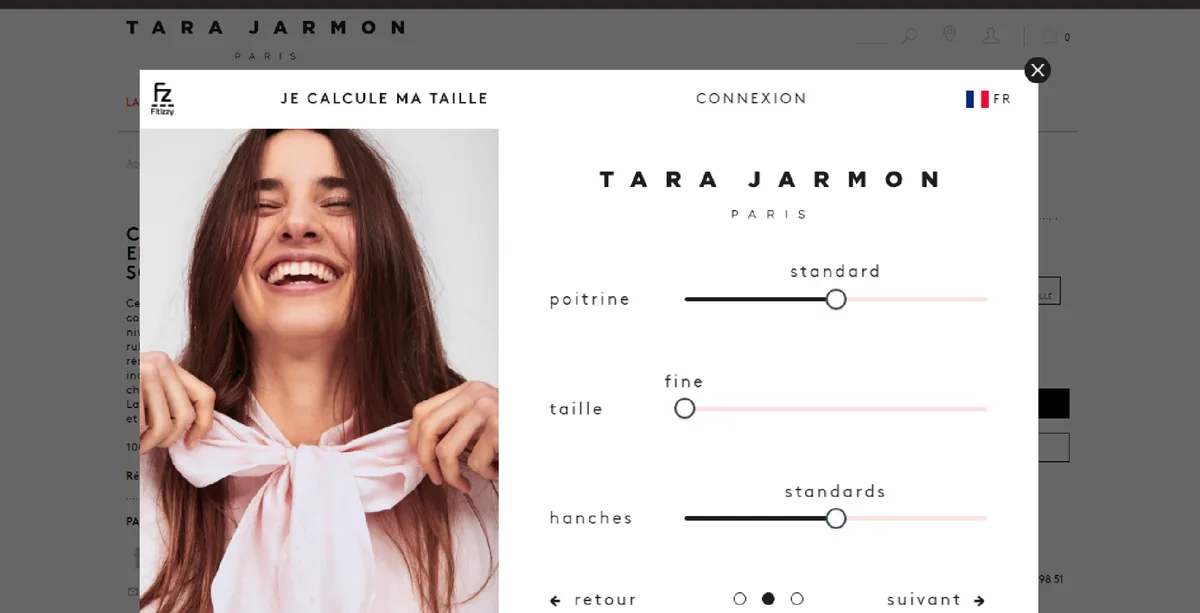
At Fitizzy, the point is not to hand out the sort of general advice every shopper can already find on any lingerie site. Our added value is advice that is considered and specific: it follows the shopper’s own body shape, and it follows the way each of the lingerie brands we work with cuts its sizes.
Bra size chart
Your underbust gives the band size and the gap between it and your bust gives the cup. France writes the band 15 higher than the rest of Europe, so a European 75 is a French 90, and the UK and the US measure the band in inches.
Band size
| Underbust | UK and US | Europe | France |
|---|---|---|---|
| 63 to 67 cm | 30 | 65 | 80 |
| 68 to 72 cm | 32 | 70 | 85 |
| 73 to 77 cm | 34 | 75 | 90 |
| 78 to 82 cm | 36 | 80 | 95 |
| 83 to 87 cm | 38 | 85 | 100 |
| 88 to 92 cm | 40 | 90 | 105 |
| 93 to 97 cm | 42 | 95 | 110 |
| 98 to 102 cm | 44 | 100 | 115 |
Cup size
| Bust minus underbust | UK | US | Europe and France |
|---|---|---|---|
| 12 to 14 cm | A | A | A |
| 14 to 16 cm | B | B | B |
| 16 to 18 cm | C | C | C |
| 18 to 20 cm | D | D | D |
| 20 to 22 cm | DD | DD | E |
| 22 to 24 cm | E | DDD | F |
Example: a 76 cm underbust and a 91 cm bust, a 15 cm gap, make a 34B in the UK and the US, a 75B in Europe and a 90B in France.
These figures follow the European standard EN 13402. Every brand cuts its own way: between two sizes, try the next band and adjust the cup, because a 34B holds the same volume as a 32C or a 36A.
Choosing the right shape of bra
Triangle, balconette, underwired or not… the choice is wide and lingerie brands offer a rich, varied range. The best way to choose is to go for the shape that suits your bust.
Fuller busts
Women with a fuller bust need to pay particular attention to the bra they choose. What matters most here is support, to avoid back pain and, over time, a bust that drops faster.
The full-cup bra was designed for exactly that. It comes up high between the breasts to structure and properly support the bust. The back is wide and the cup covering: it encloses most of the breast and rises gradually into a triangle that meets the strap. Go for wide straps — the thinner they are, the more they dig into the shoulder and the more uncomfortable, even painful, they become.
The underwired bra is recommended for women with a large bust. The wires should run under the cup and along the sides. Full-cup models already have them, so if that is the shape you are going for, you are covered. Some even have a third wire across the top, which is ideal for the largest busts.
The balconette bra is the model to pick for a rounded neckline. The straps are set wide apart and the cups are cut low, leaving the top of the bust visible. It gives a pretty neckline and stays comfortable, and it is recommended for cup sizes below an E.
Do not forget to adjust your straps properly. Loosening them does nothing to disguise the size of the bust: it only encourages back pain and a bust that drops faster.
Smaller and average busts
Women with an average or smaller bust (below a 95 C in French sizing) have a wide choice of models. We would still suggest avoiding very covering bras, which hide too much of the bust.
The balconette bra suits almost every bust size. Women with a small bust should take extra care that the cups sit closely against the breast and that the straps are properly adjusted.
The push-up bra is perfect when you want more volume. These models draw the bust towards the middle and add a little depth to the neckline.
The triangle bra is particularly well suited to smaller busts. It gives the neckline a natural look and follows the shape of the breast lightly.
The bandeau is not really a bra, but it does support all the same. It is a real ally for women with a small bust who want to wear bustiers and backless tops: it gives a degree of support without flattening the bust, and it stays discreet.
Find your ideal bra size
With Fitizzy there is no need to take your measurements, nor to remember which size works on which bra model. Our size recommendation adapts to lingerie, through an algorithm built on the shape of each body.
It sits on the product pages of the brands that adopt it: ask us for a demonstration.
(Source for this article: urbangirl-mode.fr)
Frequently asked questions
How do I work out my bra size?
Measure your underbust, just below the breasts, then your bust at its fullest point. The first gives the band (75 cm is a 34 in the UK and the US), the gap between the two gives the cup: about 13 cm for an A, 15 cm for a B, 17 cm for a C.
How do French and European bra sizes differ?
The French band is the European band plus 15, so a European 75B is a French 90B. The cup letter is the same in France and in the rest of Europe.
What if I am between two sizes?
Keep the same cup volume and change the band: if a 34B is too tight, try a 36A, and if it gapes, a 32C. The band should sit level across your back without riding up.
How do I convert a UK or US bra size to a European one?
UK and US bands are in inches: a 34 is a European 75 and a French 90. Cups match up to D; after that a UK or US DD is a European E, and a UK E is a European F.